
Green Dancing
My final project combines my love of dance and nature. I have always wanted to perform a dance outside and this was a great opportunity to combine dance with research of the outside world. This location is near my house in Asheville where I often go to hike. The location was a very important factor in the process because I needed a totally natural space that was safe to dance in.
Dancing outside was a freeing and refreshing experience. The choreographic process was based on a dance technique called Silvestre Technique. I began learning about this technique in my modern class this semester, thus being able to blend my inquiry topic outside of Writing class. It is founded upon the elements of nature: Earth, Water, Air, and Fire. Each of these elements are represented by different positions which are seen in this dance.
Pictured below are the elements and their positions.

Earth

Water

Air

Fire
Dancing outside was a new way to experience the healing power of nature. I felt much more connected to nature when dancing this dance outside, rather than when I was choreographing the dance in a indoor studio. I was able to experience the wind blow through my hair, the sunshine on my face, the lumpy earth beneath my feet, and prickly plants when I rolled on the ground.
When putting this dance together, I kept in mind the fires that have been raging in Western North Carolina. During the days that I filmed the dance, the smoke was still causing air quality warnings in the area, thus the sky is not a clear blue in the video. Dancing outdoors was a way that I could give appreciation to nature during this time of drought.
The Human Body and Nature
Imaging Studies
Figure 1
Several studies involved with measuring brain activity through sequences of images have been done to discover how our brain perceives nature.
In a recent Korean study, volunteers' blood flow to the brain was measured by a fMRI while they were showed urban verses natural scenes.
Urban scenes produced a larger blood flow to the amygdala. The amygdala is the part of the brain that processes fear and anxiety.
On the other hand, pictures of natural settings activated more blood flow to the anterior cingulate and insula. These areas are most commonly associated with empathy and altruism. Perhaps time in nature can make us nicer and calmer?
(National Geographic)
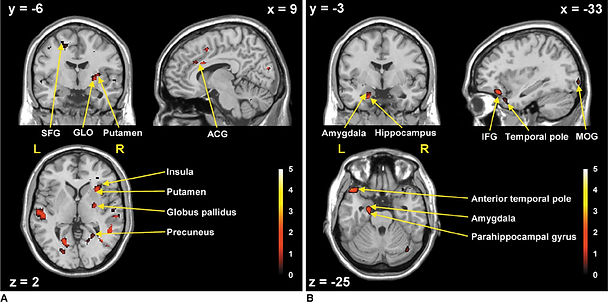
This image shows brain activity in the amygdala (activated during urban scenes) and the insula (activated during natural scenes). (Korean Journal of Radiology)
Walks in Nature

Hiking at Triple Falls in DuPont State Forest to observe nature and its effects.
One of the most common studies done to measure the effects of nature on the human body is simply a walk in nature.
Walks in nature have shown
-
a reduce in stress
-
improved attention span
-
increased memory/ problem solving skills
Stanford researcher, Greg Bratman did a study with 38 volunteers who walked for 90 minutes in nature or a busy street in downtown Palo Alto, CA. He measured the brain activity in the subgenual prefrontal cortex. The volunteers who walked in nature showed a decrease in activity in this area of the brain which is tied to depression. (National Geographic)
Just a short walk in nature can be beneficial to your health and if you can't get outdoors, even a photo, open window, or plant in your house can help!
Negative Ions
Figure 2
Negative ions are much more abundant in nature than industrialized settings. What are negative ions? They are negatively charged oxygen atoms that are created by friction when the particles split. High concentrations of negative ions in nature are found at waterfalls and running bodies of water or during thunderstorms.
Negative ions are beneficial for us because they help cleanse the air. This happens when negative ions attract positive ions that are carrying pollutants. The molecule then become too heavy and falls down, out of breathable air.
Negative ions have also been linked to alleviating stress by reducing the stress hormone, cortisol, in the body.
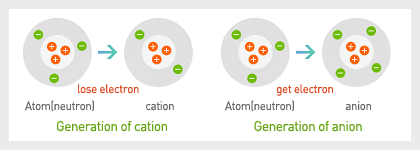
This chart demonstrates the formation of negative ions (anions, pictured on right) and positive ions (cations, pictured on left). As you can see, the negative ion has an extra electron, giving it a negative charge.
How can negative ions reduce stress?
Negative ions stimulate our reticuloendothelial system which is a group of cells that fight against disease in the immune system. This system is inhibited by the stress hormone, cortisol.
Natural Stress Response of Humans
-
When a stress is triggered, the hypothalamus in the brain sets of a chemical alarm.
-
This alarm prompts the adrenal glands to release a surge of hormones including adrenaline and cortisol.
Effects of Cortisol
-
increases the brain's use of sugars to repair tissues
-
suppresses immune system
-
suppresses digestive and reproductive systems
-
communicates with brain to control moods such as motivation and fear
Some of these effects are essential to survival, but too much cortisol can create long term health detriments. By surrounding yourself with a higher concentration of negative ions, you will have less cortisol in your body, therefore a stronger immune system. (Mayo Clinic)